
- News
- City News
- bengaluru News
- Karnataka election 2018: Voting gives citizens rare sense of empowerment
Trending
This story is from April 11, 2018
Karnataka election 2018: Voting gives citizens rare sense of empowerment
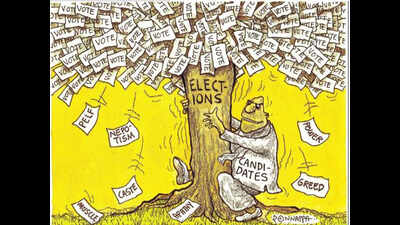

What explains this heightened excitement about elections, especially in rural India? Several factors seem to contribute to the celebration of this ‘festival’ of democracy. Elections are that one visible ‘window’ of Indian democracy that is wide open. This has often made people wonder whether India is an ‘Election Only’ democracy. The country now holds reasonably free and fair elections and voters exercise their franchise with a level of secrecy, independence and autonomy that is rarely seen in other domains. It could also be argued that voting is that one moment at which a citizen experiences a rare sense of empowerment of participating in choosing an elected representative, possibly even deciding which party will govern.
One also notices a heightened sense of involvement in the voting process among the less socially and economically privileged. Those who vote in larger numbers often represent those whose welfare and wellbeing is closely linked to government policy. Thus, that important ‘act of voting’, signifies an active involvement in decision making relating to their future.
In 1999, while conducting a survey during the Lok Sabha elections, a student of mine returned with an interesting experience. She had reached a village on a day of voting and at 8am, she was shocked to see a long line of people waiting to vote.
Having grown up in a city, she had never seen people lining up in such large numbers to vote. She spotted a middle-aged woman in that line and decided to interview her after she had voted. Approaching the woman, the student asked her who she voted for. The woman nonchalantly replied, ‘I do not know’ (she meant she did not know the name, but voted for the symbol).
My student then asked her, ‘Will voting make any difference to your life’? The woman again replied, ‘No, it will make no difference’. ‘Why then did you stand for more than half-an-hour to vote’, the student asked? The woman looked at my student and asked her whether she knew who was standing behind her in the queue.
When my student replied in the negative, she said the richest landlord of the village was behind her. Behind him, she said, was the priest of the only temple in the village and behind him was the labour contractor who hired her as a daily-wage labourer. My student was confused. The woman then asked my student, ‘Child, is there any other line in this country when I can do my job before all these people can do their job? It is only on Election Day, if I come early, I stand ahead of all these people’. My student realized that elections are not primarily about voting, but a fundamental social transformation. This, perhaps, explains the excitement around elections.
(The author is pro vice-chancellor, Jain University)
End of Article
FOLLOW US ON SOCIAL MEDIA










Photostories

Hot Picks
TOP TRENDING
Popular Categories
Hot on the Web
Top Trends
Ratan Tata HospitalisedIND vs BAN Live ScoreIND vs SL Live ScoreNew UPI Transaction LimitHurricane MiltonWorld First Top 10 TrillionairesStock Market TodayKerala Lottery ResultElection Results 2024Tom BradyIsrael Hezbollah WarSuryakumar YadavManagement Colleges of IndiaTop Medical Colleges of IndiaTop Engineering Colleges of IndiaTop Pharmacy Colleges of IndiaLive Cricket Score
Trending Topics
Diwali WishesBigg Boss Tamil 8 Contestants ListBhool Bhulaiyaa 3 TrailerDurga Puja WishesSanjay Leela BhansaliVettaiyan ReviewBigg Boss 18 House PhotoDevara CollectionBigg Boss 18Deepika PadukoneShailesh LodhaDevaraColdplayNational Film Awards 2024Swatantrya Veer SavarkarColdplay India tour 2025Watch NFL Live StreamDress To ImpressRatan TataWordle Answer
Living and entertainment
Latest News
CATS YouTube codes for October 9, 2024: Earn 500 CATS and know how to redeem the codesTHE World University Rankings 2025: IISc Leads India , Check the List of Top 10 Indian Institutes HereAre HDFC Bank, Axis, Kotak a value buy or value trap for investors?Triptii Dimri on emotional struggles following criticism for 'Animal’: Side effect of being in a mainstream filmDid the threat of ‘first Hindu CM’ help NC-Congress win J&K?Ranbir Kapoor's UNSEEN BTS pic from 'Shamshera' goes viralMudassar Aziz: A filmmaker needs to carefully study while pegging a film around the idea of stardomPrabhas starrer 'Kalki 2898 AD' gears up for its release in JapanWho is Aniruddhacharya Maharaj? Know more about Pookie Baba’s life journey and net worthOnly a true creative genius can spot the odd unicorn in 12 seconds!Will Allu Arjun be able to beat Prabhas in North America with Pushpa 2?OnePlus 12 is available for Rs 35,314 only on Amazon; check exchange deal and bank offersIndian man goes ‘skinny-dipping’ at an Australia's beach that isn’t even on Google Maps | Watch video"We all still love him": TNA producer and former Knockouts Champion hopes for AJ Styles’ return to the company"She's garbage": Raheem Mostert's Wife, Devon, Calls Out Kamala Harris Over Controversial Hurricane Milton RemarksAnupama's 15-year leap: Toshu's transformation and new actor Manish Nagdev joins amidst dramatic fire crisisAamir Khan takes Amitabh Bachchan back to his Kolkata days300 kg tea adulterated with coconut shell powder seized in this city
Copyright © 2024 Bennett, Coleman & Co. Ltd. All rights reserved. For reprint rights: Times Syndication Service